Spring soon–(sort of)

chick1

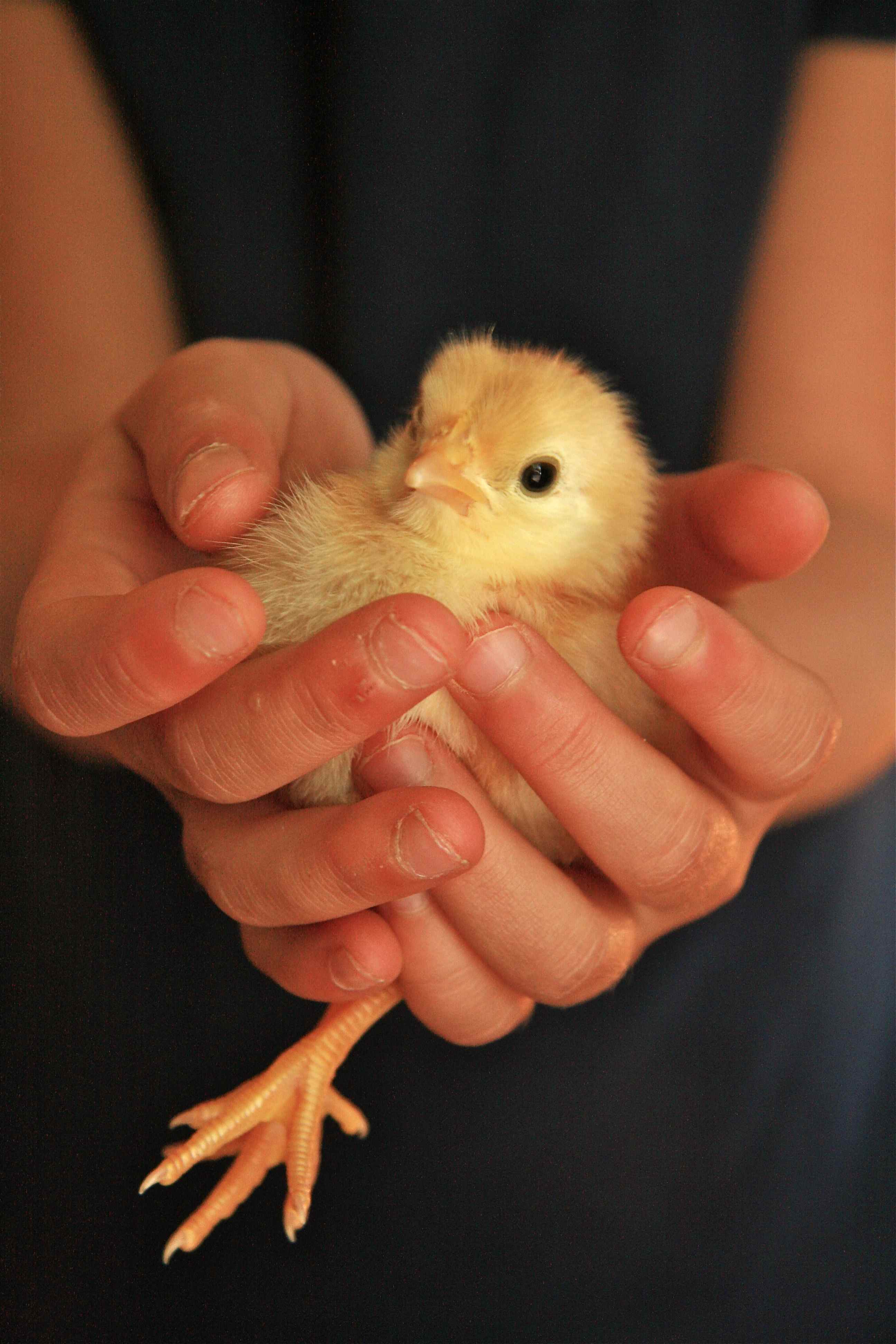
It’s March, and if we can’t have pics of flowers in bloom or green sports fields then we’ll settle for a cute chick.

The calendar says March, but looking outside tells me something different.  I think we’re doing better with our snow here and now than Sochi ever did for the 2014 Winter Olympics.

The high school and university student athletes in central Ohio, where I am writing this blog post, are trying to train for their spring sports–track and field, lacrosse, baseball; but they are definitely doing most of it indoors still.  We are all wondering if the snow will still be around when competitions begin by the end of the month. Imagine a steeplechase pit full of ice–now that’s an incentive to work on your steepling form you distance runners!

There are signs of Spring, of course.  One of my household chickens was squawking the other morning, and on investigation we discovered the first egg of the new year.  It had been four months since that last happened!!!

Moving from the backyard to the sports world: the NCAA college basketball world is heating up with pre-March Madness craziness.  Can Kentucky complete a perfect season, something not done in DI men’s basketball since Bobby Knight’s Indiana Hoosiers did so in 1976? We’ll soon find out.

And then, there is the March issue of the journal, which will have hit your respective iPads, inboxes (via eTOC) or mailboxes by now.  The promise of spring is surely within those covers:  we have the research and case abstracts from the upcoming American Medical Society for Sports Medicine (AMSSM) annual meeting, to take place in balmy Florida mid-April. Dip into those abstracts and feel the warmth of the subtropical sun!

There are several very interesting pieces of original research in the new CJSM, including one on risk factors for acute mountain sickness authored by a group from Taiwan, one which I have previously profiled here on the blog.  There are links on the main page as well to our ever growing library of podcasts.  If you missed our most recent interview with Chris Nowinski of the Sports Legacy Institute, it’s never too late:  all the podcasts are archived and can be obtained in multiple ways, including iTunes.

There will be many blog posts coming profiling all the contents of the issue.

As the Northern Hemisphere turns more, day by day, toward the warmth of the sun, we know that Spring will inevitably arrive.  In the mean time, for all of you still under Winter’s domination and beyond:  enjoy the wide world of sports medicine with us–in the journal, here on the blog, on Twitter, and in our podcasts.


In the Press

buttons 2

Our Main Website is a treasure trove of information: radio buttons often highlight associated characteristics of individual studies

The Atlantic, a highly-regarded monthly magazine published in the United States, recently published an article entitled “The Genetics of Being Injury Prone.”  It has garnered a lot of buzz on social media.

The study chiefly referenced in the article was recently published in our January 2015 CJSM:  “The Dawning Age for Genetic Testing in Sports.”  I found the same study–the lead study for the January CJSM–to be so important to disseminate that I blogged about it a month ago, and am reblogging that post (see below) so the study and the concept get the attention they deserve.

The Atlantic article went on to cite another CJSM study from 2013, as well:  Collagen Genes and Exercise-Associated Muscle Cramping, which I commend to you as well.

Enjoy the studies, the blog posts, the Atlantic article.  And take the time to head to our main website at cjsportmed.com, a treasure trove of information:  studies, polls, podcasts……An interesting feature of the site are the ‘buttons’ next to published studies that may be ‘inthe news,’ ‘open access,’ ‘free,’ or have other media associated with them–blog posts, podcasts, and the like (see above image).

Have a great weekend.

sportingjim's avatarClinical Journal of Sport Medicine Blog

The recent NFC championship game proved, I think, this truth: a true champion is not dead until the final whistle blows. The Seahawks  won in dramatic fashion over the Packers, my favorite team.  As many commentators noted, Seattle played horribly for 58 minutes, but were stellar for the last two; and that was all that mattered in the end.

As a fan, my initial reaction is to think “we gave it away.”  But that is a disservice to the champions.  The Seahawks never lay down, and they seized the moment when it presented itself.

Still…..as a fan, I wonder–if Aaron Rodgers’ calf were 100%, would we have pulled away more decisively earlier in the game?  The field goals in the red zone: would they have been touchdowns instead if our quarterback had his usual mobility?

Bdna_cropped Does Rodgers carry a valuable SNP in the genes of his gastrocnemius? I…

View original post 563 more words

Placebos & Cyclones–it’s becoming even more interesting at ACSP

image1 (2)

ACSP members learning how to manage trauma on the pitch.

The Australasian College of Sports Physicians (ACSP) has been holding its annual conference in Coffs Harbour, NSW.  We have one more post coming from our intrepid correspondent Dr. Hamish Osborne.

Yes, ‘intrepid’–as he remains on site for the end of the conference and post-conference proceedings,  Cyclone Marcia approaches.  Hamish, I wish we had a live feed showing the wind whipping your hair while you stand on a quay.
In truth, stay safe: and we look forward already to your posts from the next ACSP meeting.
____________________________________________________
As a category 5 cyclone bears down on our coast the Australasian College of Sports Physicians annual scientific conference has drawn to a close. The most fascinating talk  on the final day was by A/Prof Damien Finniss from University of Sydney. He is a pain specialist with a special interest in placebo. You don’t have to deliver a placebo for placebo to be working. The social interaction of a consultation, context, cost, choice of words all have a placebo effect that overlays our intervention. This means we as clinicians are using placebo all the time in practice – wow, just now need to think a bit harder about that and how to be more efficient when using it.
Not all of us have gone home from conference – 40 fellows and trainees have stayed on for a Management of Sporting Trauma course. Basic and advanced life support skills and management of serious acute conditions are important skills that every sports physician hopes they never have to use on the side of a sporting field.
So tomorrow we will finally wrap it all up and hopefully be out of beautiful Coffs Harbour before the storm surge and rain flood our way out. Keep an eye out on our website for next year’s conference location and dates.  Remember February in Australia is (normally) warm/hot and the scenery world renowned. Would love to see you all down under next February – put it in your diary.
____________________________________________
Thanks again Hamish.  And Cyclone Marcia is no figment of the imagination, for sure:  get out of Coffs Harbour in one piece!

hamish

The intrepid Hamish Osborne: our CJSM reporter and ACSP instructor

To our readers, I’d encourage you to check out just one of CJSM’s offerings on the issue of placebo in sports medicine:  a fine 2008 piece of original research from (fittingly) an Australian group, “Characterizing the Effectiveness of the Placebo Effect in Sports Medicine.”  Listening to Dr. Finniss, reading the research, we all might just approach our next patient in a slightly different, more efficacious manner.

Australasian College of Sports Medicine: Galas, Golf & Geriatrics (and some Surfing)

image1

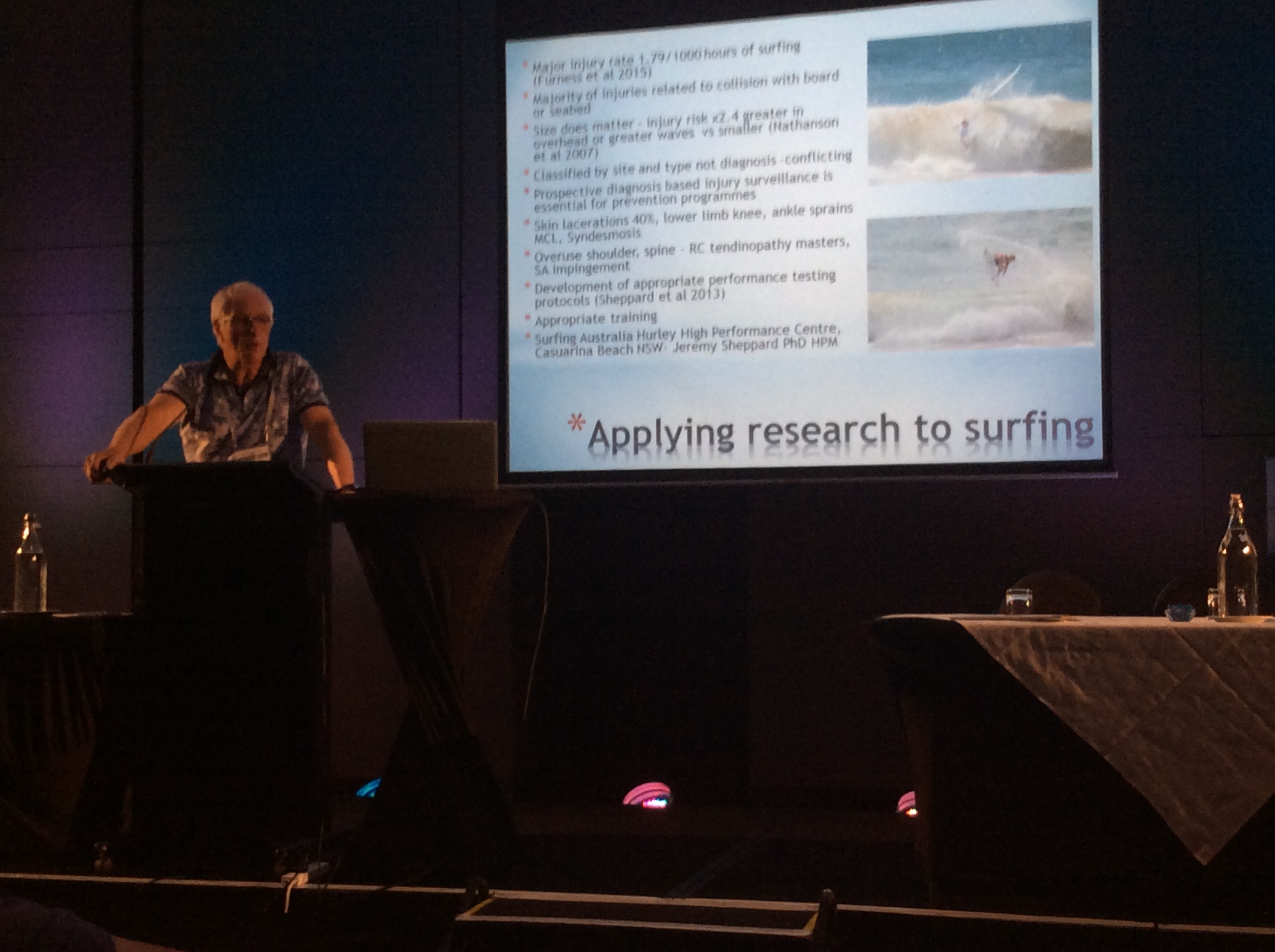
Dr. Stu Watson, lecturing on ‘surfing medicine’

Those of you who follow this blog likely read the most recent post, which was coming to you from Down Under courtesy of Dr. Hamish Osborne, a member of the CJSM Editorial Board.

Dr. Osborne practices in Dunedin, New Zealand, and is a member of the Australasian College of Sports Physicians (ACSP), one of this journal’s partner societies.   The College is having its annual conference in Coffs Harbour, NSW, and Dr. Osborne is reporting on the proceedings.
Without further ado:  Dr. Osborne!
________________________________________
The  morning after the night before–big celebrations last night here at the ACSP Conference at Coffs Harbour.  At the annual gala dinner fellowship certificates were presented to 5 recently completed trainees. The dinner was preceded by our annual general meeting at which major constitutional overhaul has set the college up to spend a lot more of our time and effort in further developing our training, education and research programs. Celebrations for both of these occasions went deep into the evening (and perhaps for some into the small hours).
Dr Stu Watson, one of our founding members and second president of the College, gave us a very interesting presentation on the literature and science being used in one of his favourite passions – surfing. These athletes are using FIFA 11plus protocols and Olympic lifting in preparation for surfing and prevention of injuries; it’s not just about slipping on your wetsuit and hitting the lip.
My favourite talk so far was by Prof. Marie Antoinette Fiatarone Singh from University of Sydney. She is a geriatrician and researcher focusing on integration of geriatric medicine, exercise and nutrition. She practices in Sydney but also has board certification in internal medicine and geriatric medicine in the USA. While we know that exercise is good for arthritic knees, pain can effectively limit the amount of walking a patient may get.  Dr. Singh emphasized that we clinicians try not to get these patients to walk; rather, they should lift relatively heavy weights through a somewhat limited range of motion initially,  and then they may progressively add range of motion and aerobic fitness as the increasing strength allows. It’s likely that this method is a disease modifying treatment!
This afternoon we will be off to practice what we preach:  a round of golf, which will have most of us exceeding our weekly required dose of walking for health. It might be the only preparation I get for the conference fun run tomorrow morning.  Hopefully, my swimming fitness will translate nicely to a short run.
Looking forward to the Management of Sporting Trauma (MOST) course later in the week. Watch out for my next post from there and a wrap up of the conference.
__________________________________
Thanks Hamish!  Your reporting gave me a sense of deja vu regarding another college of sport medicine:  the American College of Sports Medicine (ACSM).  As a Team Physician for the University of California, Santa Cruz, I once gave a talk at an annual ACSM meeting on surfing medicine; I would love to have sat in on Dr. Watson’s talk.  And I am happy to say I got a chance to catch Dr. Fiatarone Singh at last year’s ACSM meeting, and I concur:  she does a fabulous job discussing her years of research on the application of resistance training to the health and wellness of the elderly (and that work is frequently referenced in manuscripts in our own publication).
Enjoy the proceedings (and we hope you break par)!