5 questions with Robert Zayas, New York State Public High School Athletic Association

State Wresting Championships 2013 II

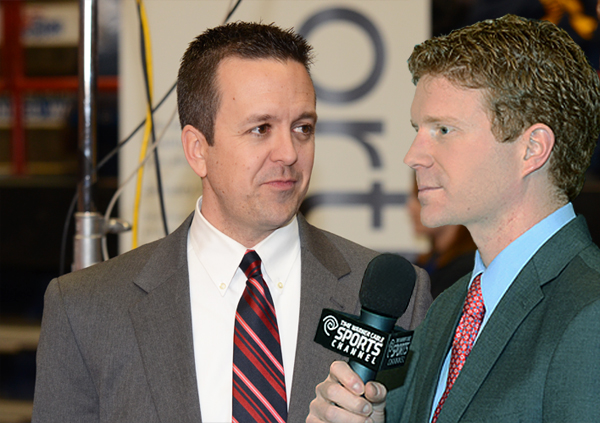
Robert Zayas (left) at New York State Wrestling Championships 2013

We are delighted to have Robert Zayas, Executive Director of the New York State Public High School Athletic Association (NYSPHSAA), join us today for our “Five Questions with CJSM”  feature.

I met Robert at an inaugural meeting of the National Youth Council on Sports Safety (NCYSS) in Washington, D.C. last November, and I have been after him ever since to sit down with us to share his unique perspective on American youth sports.  He’s a busy man, as you’ll see, and so we’re all fortunate to have him join us.

With a clinical practice in pediatric sports medicine, youth sports are never far from my mind.  In D.C. Robert and I had a chat about some of the challenges facing the kids and adults involved in contemporary youth sports:  early sport specialization (the focus of an earlier blog post); the rise of youth league sports in parallel with interscholastic sports; the unique pressures the American athletic scholarship phenomenon places on young athletes; the evidence that participation rates are declining in landmark sports like football and soccer……it’s a world in flux, with lots of questions.

And so it’s great to have people like Robert Zayas involved in guiding the ship through these changing seas.

_________________________________________

1) CJSM: Congratulations! You have recently been named to the National Council on Youth Sports Safety.  Can you tell us a little bit about the goals of the council, and what you hope to contribute to the process?

RZ: Thank  you; it is truly an honor to serve as a member of the National Council on Youth Sports Safety.

In its first year, the NCYSS will meet quarterly to review existing research, explore alternative solutions, and develop a strategic plan for the implementation of a national set of guidelines on youth sports safety. The second year will include a best practices tour where the public will be provided with opportunities to learn about scientific and technological advancements, effective coaching and training techniques, and contribute feedback on methods that have led to a decline in injury in their respective communities.

I hope to represent the high school sports view-point on the council.  Most importantly, I hope to ensure interscholastic, education based sports are seen as an extension of the classroom and the impact concussions are having on the “student” in all areas of education.

2) CJSM: You are the Executive Director of the NYSPHSAA.  Can you tell us a bit about your background and what you see as the mission of the association?

RZ: My background in education and athletics spans a very short period of time when compared to other Executive Directors throughout the country.  Read more of this post

Computerized Neurocognitive Testing in the Management of Concussions, Part 2

Leather_football_helmet_(circa_1930's)

Concussion management for football,
c. 1930

I woke up this morning to my usual Sunday routine:  the New York Times Sports page and coffee.

Today’s sports section–and I don’t think the Times is alone in this regard–is devoted to the subject of the forthcoming American college football season.  The first games of the season will take place this Thursday, August 29.  As the Times puts it, “The nation’s annual rite of mayhem and pageantry known as the college football season begins this week…..”

When I’m not doing work with the Clinical Journal of Sports Medicine, I’m taking care of youth, high school and college athletes; for my colleagues and me, the football season has already begun, with the various teams we cover already having had weeks of steady, increasingly intense practices and scrimmages.  And we’re seeing the injury results of the sport, including an increase in volume of concussions.

I’ve mentioned this in my blog posts for this month, where the theme has been ‘concussions.’  Last week I wrote about the special set of CJSM concussion research articles we have made freely available for a limited time.  At the beginning of the month, I authored a post on the subject of computerized neurocognitive testing (e.g. ANAM4, CNS-Vital Signs, AxonSports,  ImPACT, etc.) and their use in managing concussions.  I want to return to that subject in today’s post.

axon sport macdonald

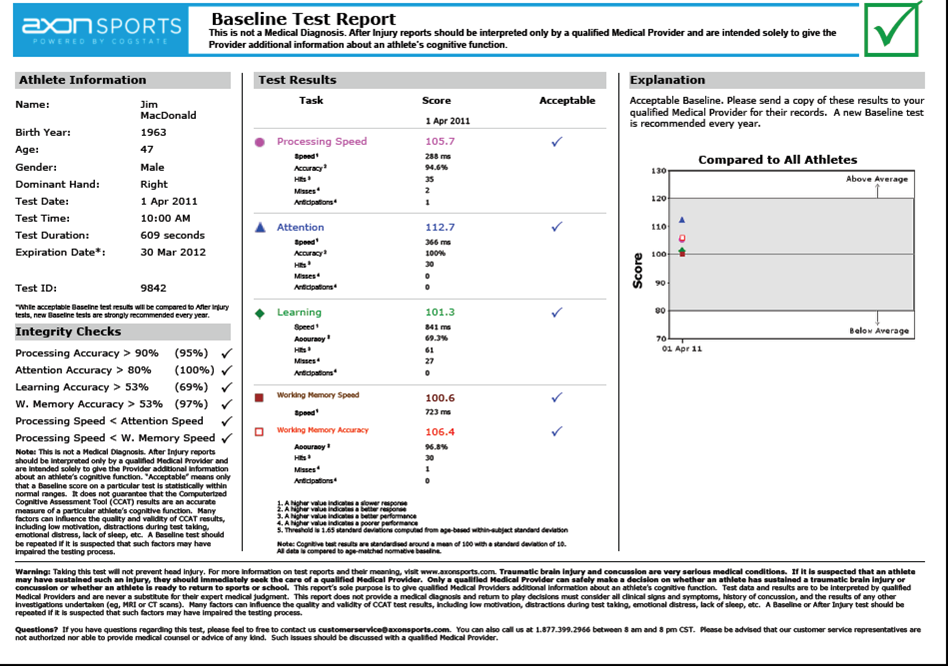
The author’s baseline AxonSport report

A recent article from the Archives of Clinical Neuropscyhology was especially interesting, I thought. The authors looked at a military population while evaluating the test-retest reliability of four computerized neurocognitive assessment tools (NCATs):  Automated Neuropsychological Assessment Metrics 4 (ANAM4), CNS-Vital Signs, CogState (available now in the U.S. as ‘Axon Sports’), and ImPACT).  I’m familiar with these products, but most especially ‘know’ CogState, as this is the NCAT we use in our clinic.

The authors correctly assert that test-retest reliability is one of the “…fundamental psychometric characteristics that should be established in each NCAT,” and that “….reliability should be established before making conclusions about a test’s validity,” which is the psychometric construct that can indicate whether a test measures what one is truly trying to measure (for instance, ‘reaction time,’ or ‘memory’).  Reliability, is the “…extent to which the test produces consistent results across multiple administrations to the same individual.”

In this study of 215 individuals (mean age 34, range 19 to 59), Read more of this post

Risk / tolerance approach in return to play decision making – the right approach?

This month’s Editorial in CJSM by Levy and Delaney highlights the issue of the role of the Team Physician in the process of the Preparticipation evaluation.

Team Doctors are often called upon to make a decision about the suitability of an individual for return to play. In this role, the burden of responsibility for the decision making process is likely to lie with the clinician, at least in the first instance, whether or not the team manager and the player decide to follow their advice.

Few would argue that the clinician is best placed to make a definitive ‘medical’ decision on return to play decisions since they are likely to have the most educated opinion about decisions related to the health of the player within the team environment. However, the question of where the responsibility should lie with the ultimate decision made is a contentious one.

In the context of return to play decisions, the clinician offers a medical opinion based on the suitability of the player for a return to play, taking into account the potential risks to the individual. These may include a worsening of a pre-existing injury or medical condition, together with the  potential for further injury or illness as a result of a return to participation in sport.

The factors governing medical decision making in these circumstances are many, and include the clinician’s prior level of medical knowledge, defensive practice and risk-taking in clinical decision making, conflicts of interest (for example doctor versus fan and player versus team), pressure from external sources on return to play, the availability of sports risk modifiers, and the clinician’s perception of the risk ratio of benefit to harm for the patient. On occasion, the clinician must also consider the potential risks to others involved in sport of a participant’s return to competition, for example, with motor vehicle racing in the case of a driver with epilepsy.

Return to play decision making from the coach’s point of view may be governed by a different set of variables including contract issues, perceptions about the importance of the next game and the importance of the particular player to the team, the availability of other players, pressure from internal and external sources, and differences in perceptions about clinical risk to benefit ratios.

Similarly, from the player’s point of view, important factors in their decision making on return to play include their understanding of their own injuries or medical conditions, individual risk-taking behaviour, contract issues, and pressures from internal or external sources.

The key difference in decision making between these three different sources is that the clinician is morally and duty bound to consciously consider the welfare of their patient in the first instance and to prioritise this in their decision making process, whereas the coaching staff may have an entirely different set of priorities, and the player may well put other factors in front of their own health.

Who should have the final say on return to play decisions?

As described in this month’s CJSM Editorial by Levy and Delaney , the authors take a novel ‘risk / tolerance’ approach in the preparticipation evaluation setting, starting with a clinical assessment of risk made by the team medical staff based on four different risk category classes, which are in turn based on subjective criteria of the medical team’s perception of risk to an individual of participation in sport. This risk category class is then shared with the management and with the player, and the management then make their own decisions based on this information.

The authors argue that this is a transparent system which can serve to inform and to help everyone involved, and removes the clinician’s absolute responsibility in the decision-making process.

However, a question one might ask is it simply passing the buck? Taken to its logical conclusion, this could result in a return to play for a player whom the medical staff consider is medically unsuitable for play. Is this the right approach?

Creighton and colleagues previously published a 3-step decision-based return to play model in an attempt to clarify the processes that clinicians follow both consciously and subconsciously when making return to play decisions, and to provide a structure for this decision making process.

Could Levy and Delaney’s risk / tolerance approach model logically follow on from the 3-step decision-based return to play model described by Creighton and colleagues? Would this work in Practice? Do any of our readers currently adopt a similar approach, or is this just a simplification of a far more complicated decision-making process?

CJSM would like to hear your thoughts.

References

Leave a Comment

Leave a Comment

1) Levy, David ; Delaney,  J.Scott. A Risk/Tolerance Approach to the Preparticipation Examination. Clin J SportMed. 2012;22:309-310 

2) Creighton DW, Shrier I, Shultz R, et al. Return-to-play in sport: a decision-based model. Clin J SportMed. 2010;20:379-385

3) Shrier I et al. 2010. The Sociology of Return-to-Play Decision Making:A Clinical Perspective. Clin J SportMed. 2010;20:333-335

Photograph – Josef Schmitt – Germany FC National Football Team Doctor. Wikimedia Commons

Neuropsychological tests in sport-related concussion – are they worthwhile?

The article by Shrier in the current edition of CJSM revisits the issue of neuropsychological testing in the setting of sport-related concussion, and poses some searching questions in relation to the use of these tools in the diagnosis and management of sport-related concussion. In particular, he asks ‘…do the results of neuropsychological testing change patient management or provide other clinical benefit to the patient?’ and ‘Is there sufficient evidence to mandate it (neuropsychological testing) as standard of medical care?’ (Shrier, 2012).

Whilst it is clear that sport-related concussion is a hot topic in Sports Medicine, with an ever-increasing literature on the subject, and following three expert consensus panellist group meetings since 2001, controversy surrounding the diagnosis, management, and return to play protocols continues to rage amongst academics and clinicians alike.

In his article, Shrier concentrates on the application of neuropsychological tests to the sport-related concussion setting. Whilst it is accepted that neuropsychological tests alone are not adequate to confirm the diagnosis and dictate the ongoing management of concussion, they are currently widely used in the rehabilitation and return-to-play setting as a part of an overall neuropsychological assessment for players in elite sport suffering from a concussion – especially in hockey, and college football.

Shrier points out that neuropsychological tests are designed to give an objective assessment of brain function, but that ‘the objective in concussion management is to measure brain injury’ and points out that ‘brain injury is only one cause of decreased brain function,’ mentioning that there are several other factors that may affect brain function such as the presence or absence of other injuries or mood disorders (Shrier, 2012). The author does not point out exactly when he means by ‘brain function,’ however, nor discusses in detail any of the other multidimensional tools that may be used to assess this such as EEG and fMRI.

There are clearly limitations in using neuropsychological tests in the setting of sports-related concussion related to the issues Shrier points out in his article. However, it is important to remember that it is the application of these tests in the overall clinical context that perhaps assists the practitioner in making an informed and reasoned judgement as to whether impairment in brain function is likely to be secondary to concussion.

Further on in the article, Shrier goes on to argue that neuropsychological tests have ‘minimal value for an individual athlete and does not support mandating (their) use,’ (Shrier, 2012) and then examines the arguments for using the tests related to asymptomatic athletes at rest, athletes who are asymptomatic at rest but symptomatic on exertion, and athletes who are asymptomatic on exertion.

Whilst there is still academic debate surrounding the clinical usefulness of neuropsychological tests in the setting of sport-related concussions, doubt must also be levelled at their applicability and cost-effectiveness, a point also argued by Shrier in his conclusion. He also mentions that there are not enough neuropsychologists with appropriate expertise available to be able to warrant mandatory neuropsychological testing on a population level for them to be considered as standard of care, which is certainly true.

In his conclusion, Shrier argues that ‘NP testing provides only a small increase in prognostic information and does not change the management of athletes who are symptomatic at rest or with exercise,’ and points out that ‘There is no evidence that abnormal NP testing is associated with increased risk of further injury or delayed recovery in athletes who are asymptomatic at rest and exertion.’ (Shrier, 2012). 

The Concussion in Sport group, however,  in their last consensus statement mentioned that ‘the application of neuropsychological testing in concussion has been shown to be of clinical value and continues to contribute significant information in concussion evaluation.’ (McCrory et al, 2009).

No doubt Shrier’s article will fuel much continuing academic debate on the use of neuropsychological tests in the setting of sport-related concussion.

Are you using these tests as part of your overall concussion management programme?

CJSM would like to hear your thoughts on the debate.

References

1) Shrier i. 2012. Neuropsychological testing and Concussions: A Reasoned Approach. CJSM 22(3): 211-213

2) McCrory  P et al. 2009. Consensus Statement on Concussion in Sport 3rd International Conference on Concussion in Sport Held in Zurich, November 2008. CJSM 19(3): 185-200

Leave a Comment

Leave a Comment