Motor Vehicle Accidents: The Leading Cause of Death in Collegiate Athletes

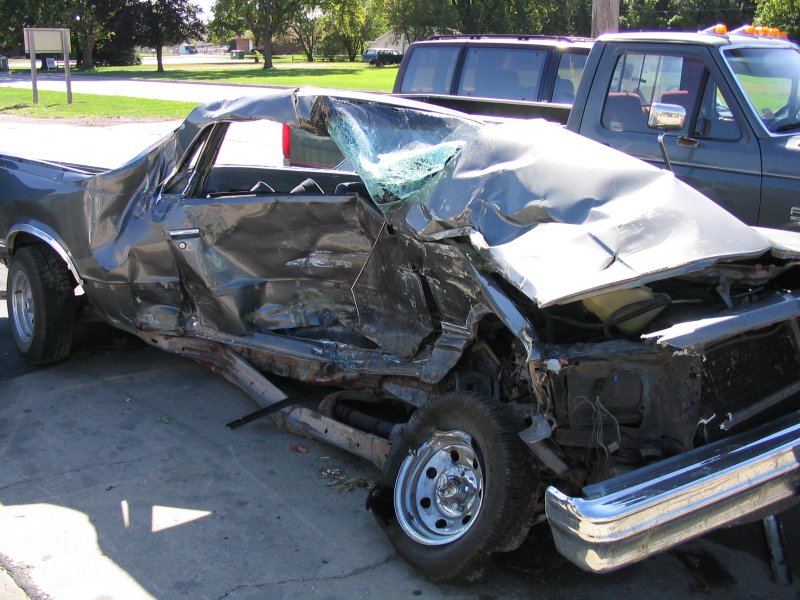
Car_crash_2

Motor Vehicle Accidents: the number one
killer of NCAA athletes

The title of today’s post is striking.

In sports medicine we focus–rightly–on entities such as sudden cardiac death, cervical spine injuries, second impact syndrome, exertional heat illness, hyponatremia……There  is a long list of conditions that can befall athletes which can cause serious mortality and morbidity.

But from a public health perspective, our priorities are possibly misplaced. At the very least I wonder sometimes if we may ‘strain at a gnat and swallow the camel‘ when we focus intensely on chest protectors and commotio cordis and say nothing about the use of seat belts in our athletes.

In August CJSM published ‘ahead of print’  “Motor Vehicle Accidents:  the Leading Cause of Death in Collegiate Athletes,” a study authored by I Asif, K Harmon, and D Klossner, authors who have published other epidemiologic work on sudden death in young athletes.  The data presented gave me pause. For all our concern about sudden death from hypertrophic cardiomyopathy,  to name one example, the data show that far and away the greatest threat to the young athletes under our care are accidents or unintentional injury.

The authors conducted a 5 year retrospective analysis using two data bases:  an NCAA database, and the “Parent Heart Watch” database.  This second database has an interesting history: a non profit group which began tracking sudden cardiac death in American athletes in 2000.   Various death rates were calculated, notably: 1) an overall death rate for athletes was found to be 13.86/100,000 athlete-years; 2) a death rate from accidents of 7.36/100,000 athlete-years; 3) a death rate from cardiac causes of 2.28/100,000 athlete-years; 4) a death rate due to accidents found highest in the sport of division I wrestlers, with a rate of 28.2/100,000 athlete-years.   Deaths from unintentional injuries occur at “….nearly twice the rate of all medical causes of death combined,” the authors note. Read more of this post

Exertional Rhabdomyolysis

I hope the blog readership has had a chance to take a look at the most recent issue of CJSM.  The September 2013 edition of the Journal has studies looking at conditions from concussion to osteoporosis and at sports from football to ballet.  It is a varied mix, and a testament to the wide range of conditions primary care sports clinicians treat and study.

Nile_Kinnick

The great Nile Kinnick,
University of Iowa
1939 Heisman trophy winner,
World War II hero

I spent a good amount of time in August talking about concussions, and I could easily continue this thread throughout September.  I started off the month, in fact, with a look at my friend Bill Meehan’s recent work on the “The Presence of Undiagnosed Concussions in Athletes.”  I thought I’d take a break from that topic, and look at a less common but also potentially dangerous condition:  exertional rhabdomyolysis.  It’s a particularly relevant topic at this moment, as exertional rhabdo often times strikes untrained athletes working out in hot and humid environmental conditions, and it’s an unseasonable 95 in Columbus Ohio today, where I am writing this post.

A Cluster of Rhabdomyolysis Affecting a Division I Football Team,” a study by Smoot, MK, Amendola, A, Cramer, E et al., looks at an ‘outbreak’ of the condition in January 2011 at the University of Iowa’s football (american) team after some intense off-season lifting workouts.  Ironically, we had a cluster of our own in Columbus, Ohio, home to Iowa’s Big Ten rival Ohio State, just this spring, in the women’s sport of lacrosse.  The LAX players were hospitalized after team members performed a new 20 minute workout involving repetitive pushups, situps and chin ups, without break.  Six female athletes were hospitalized for as much as a week.  The local newspaper reported,  “Five returned to play last season, all except sophomore Kelly Becker of Dublin…..who has since transferred to Michigan.”

mo squared at michigan

The author’s son,
letting it all hang out
in the ‘Big House’
Ann Arbor, MI

Ok, stop!!  If that doesn’t suggest to you the gravity of the situation, nothing will.  As a consequence of her experience as an athlete who developed exertional rhabdo, a young woman traded in being a Buckeye for a Wolverine.  The ultimate protest!!!!

Returning to the study…..The authors set out to look for what might be risk factors for exertional rhabdo (ER) in collegiate football players.  They begin by doing a brief and excellent overview of the signs and symptoms, defining characteristics, and known risk factors for ER.  They proceed then to describe the workout the 16 football players did (e.g. 100 back squats at 50% of one rep maximum) and how the young men presented with ER.  Thirteen players were hospitalized for ER after this workout.

The authors were given permission to look at the medical records of 10 of the 13 cases. Nine of the 10 had urine screens negative for drugs (one had a positive opiate screen, but his urine had been collected after being administered narcotic analgesics); one of the 10 had sickle cell trait; and two of the 10 had consumed creatine before the workout.

Read more of this post

Computerized Neurocognitive Testing in the Management of Concussions, Part 2

Leather_football_helmet_(circa_1930's)

Concussion management for football,
c. 1930

I woke up this morning to my usual Sunday routine:  the New York Times Sports page and coffee.

Today’s sports section–and I don’t think the Times is alone in this regard–is devoted to the subject of the forthcoming American college football season.  The first games of the season will take place this Thursday, August 29.  As the Times puts it, “The nation’s annual rite of mayhem and pageantry known as the college football season begins this week…..”

When I’m not doing work with the Clinical Journal of Sports Medicine, I’m taking care of youth, high school and college athletes; for my colleagues and me, the football season has already begun, with the various teams we cover already having had weeks of steady, increasingly intense practices and scrimmages.  And we’re seeing the injury results of the sport, including an increase in volume of concussions.

I’ve mentioned this in my blog posts for this month, where the theme has been ‘concussions.’  Last week I wrote about the special set of CJSM concussion research articles we have made freely available for a limited time.  At the beginning of the month, I authored a post on the subject of computerized neurocognitive testing (e.g. ANAM4, CNS-Vital Signs, AxonSports,  ImPACT, etc.) and their use in managing concussions.  I want to return to that subject in today’s post.

axon sport macdonald

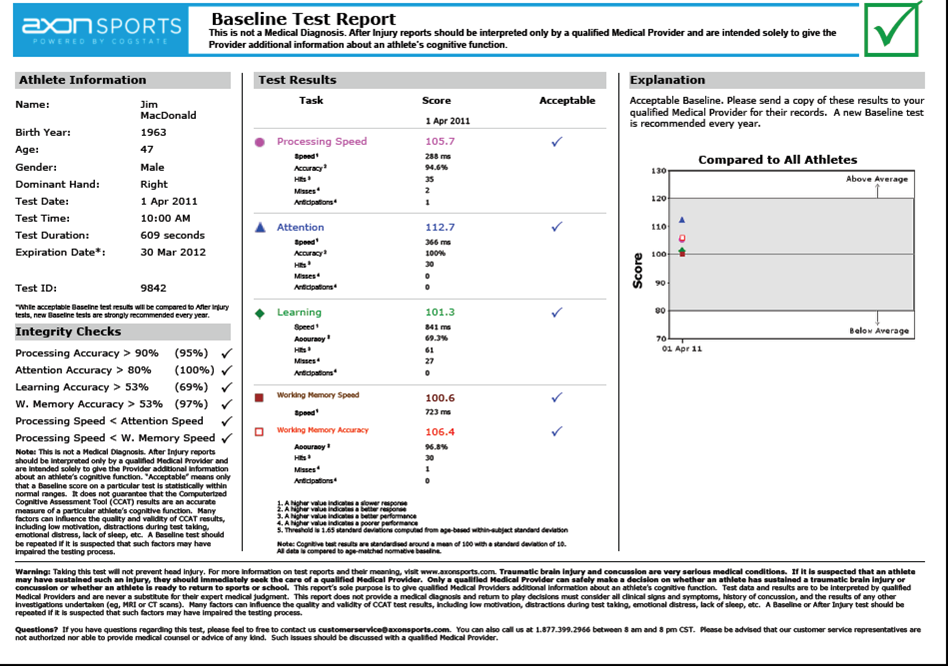
The author’s baseline AxonSport report

A recent article from the Archives of Clinical Neuropscyhology was especially interesting, I thought. The authors looked at a military population while evaluating the test-retest reliability of four computerized neurocognitive assessment tools (NCATs):  Automated Neuropsychological Assessment Metrics 4 (ANAM4), CNS-Vital Signs, CogState (available now in the U.S. as ‘Axon Sports’), and ImPACT).  I’m familiar with these products, but most especially ‘know’ CogState, as this is the NCAT we use in our clinic.

The authors correctly assert that test-retest reliability is one of the “…fundamental psychometric characteristics that should be established in each NCAT,” and that “….reliability should be established before making conclusions about a test’s validity,” which is the psychometric construct that can indicate whether a test measures what one is truly trying to measure (for instance, ‘reaction time,’ or ‘memory’).  Reliability, is the “…extent to which the test produces consistent results across multiple administrations to the same individual.”

In this study of 215 individuals (mean age 34, range 19 to 59), Read more of this post

Local anesthetic use in sport for early return to play – should we be offering these jabs?

The use of local anesthetics in sports injury management is a bit of dark art – often practised, but not so often talked about. Certainly, there is a paucity of medical literature on the subject, with perhaps more articles in the lay press.

Statistics on the use of local anesthetics in different sports are not widely available, but it is likely that they are most widely used in the contact sports including the football codes (American football, soccer, and rugby league and union).

When they are used, the aim is usually to eliminate or diminish pain caused by an injury which may be acute or chronic, or another condition such as an ingrowing toenail, significantly enough in order for a player to return to play.

Some questions remain about their use, however –

– Are they safe for players in the short and long term?

– Are we currently using them in an ethically-sound manner?

The World Anti-doping Agency currently places no restrictions on the use of local anesthetics in sport, although there is a debate about whether the elimination of pain constitutes a performance enhancing intervention. Most governing bodies leave the decision as to whether use local anesthetics to the team physician and patient. The NCAA, for example, mentions that ‘use is medically justified only when permitting the athlete to continue the competition without potential risk to his or her health.’ (see section 31.2.3.4.1 of NCAA drug policies).

The assessment of potential risk to health from using local anesthetics in order to assist a player to return to play is a difficult one. To a large extent, the risk depends upon the nature of the injury. Most of us would, I suspect, be reluctant to administer a local anesthetic to a player with an acute grade 1 medial collateral ligament injury of the knee in order for them to attempt to play, but may be less concerned about blocking a toe with an undisplaced phalangeal fracture.

Orchard and colleagues reviewed a case series of 268 injuries over a 6 year period in which local anesthetic was administered to allow an early return to play. In this series, around 10% of players competing did so with the assistance of a local anesthetic. The most common injuries for which local anesthetics were administered were rib injuries, iliac crest hematomas, acromioclavicular joint injuries, and finger and thumb injuries. A total of 6 ‘major’ complications were noted, including two cases of distal clavicle osteolysis (questionable as to whether this was a true complication), a partial tendoachilles rupture, an adductor longus tendinopathy (again, causality is questionable), prepatellar infected bursitis and a scapholunate ligament tear, with 11 ‘minor’ complications.

Orchard and colleagues went on to publish a retrospective survey of 100 players over ten seasons who had been injected with local anesthetic on 1023 occasions for 307 injuries. There was an average of 5 years’ follow-up. They found that 98% of players stated they would have had the procedure in the same circumstances again, although nearly a third felt that there were side effects associated with the use of the local anesthetic. 22% of players thought that the anesthetic had delayed their recovery and 6% thought that their injury was worsened due to playing on with a local anesthetic block.

The authors concluded that ‘the most commonly injected injuries – acromioclavicular joint sprains, finger and rib injuries, and iliac crest contusions appear to be quite safe (in the context of professional sport) to inject at long-term follow up.’

They conceded that ‘a few injuries may have been made substantially worse by playing after an injection,’ and also mentioned that there was ‘still insufficient evidence to completely determine the safety of local anesthetic injections in the majority of potential circumstances,’ calling for further studies to assess long-term safety.

There is good evidence that local anesthetic injections are both chondrotoxic and myotoxic when administered during both in vitro and in vivo studies. Given that the long-term safety of local anesthetic injections is unknown, can we safely recommend and administer these to our patients in order to allow them an early return to play?

Perhaps even more important are the ethical and safeguarding issues surrounding the use of local anesthetics in sports injury. What happens if a player chooses not to have an injection following  an injury when it is common practice amongst the team for other players to have this intervention in order that they may be able to play with a similar injury? Will they be discriminated against by the team manager or other players, or be subject to coercion?

Should there be an independent assessment of the appropriateness of using these injections prior to administration?

Do we need a review and a consensus opinion from WADA or individual governing bodies ?

CJSM would like to hear your thoughts

Leave a Comment
Leave a Comment