Ringette: Who Knew?

RingettePlayer

Ringette Player in Action!

At CJSM we are already anticipating the start of 2014:  the January 2014 issue is still awaiting publication, but we are already releasing some of this coming year’s studies in our “Published ahead of print” collection.

One I wanted to talk about today, if only because the subject sport is an entirely new one to me: Ringette-related injuries in young female players.

Ringette.  As a middle-aged guy, I know I still have a lot to learn.  That said, I am delighted when I have a day where I acquire some new fact or concept I literally have never encountered in my over 18000 days on the planet.  Ringette.  I had never heard of this sport until I read this epidemiologic study.  Nearly everything I now know about the sport comes courtesy of the authors Glenn Keays, Isabelle Gagnon, and Debbie Friedman.  Thanks to you all!

A team sport played on ice rinks, ringette is similar to ice hockey with these notable exceptions:  1) 6 skaters comprise a team; 2) the skaters advance a doughnut shaped ring, rather than a puck, with a stick that has no blade; 3) the rules governing the sport encourage the development of team play; for instance, a player that might be lionized in hockey for being able to single-handedly advance the puck the length of the rink and score is, in ringette, penalized instead.  Like competitive women’s ice hockey, ringette is a non-collision sport, with all contact between players officially prohibited.  Players are equipped with safety devices such as helmets and visors.

The sport has been around for 50 years, originating in Canada.  It is expanding internationally, with associations in the USA, Finland, Sweden and beyond.  Read more of this post

National Council on Youth Sports Safety

988780_10151971065024581_1620105790_n

Strained metaphor?
Like the Washington Monument,
our approach to concussions is
under revision

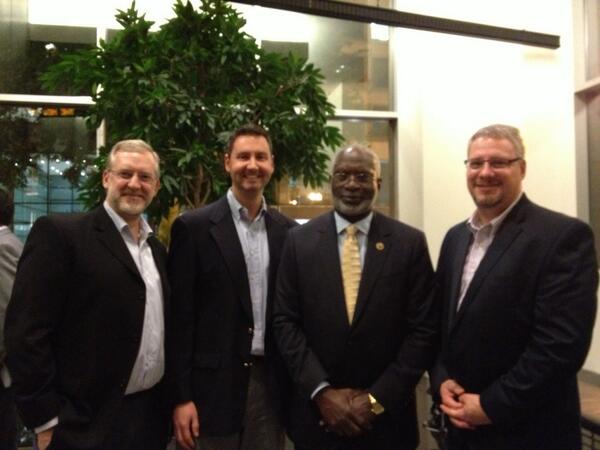
I am in Washington D.C. Thursday and Friday as a participant in the National Council on Youth Sports Safety (NCYSS), being put on by the Protecting Athletes and Sports Safety (PASS) Initiative.  Our host and keynote speaker is Dr. David Satcher, the former Surgeon General who has devoted his life to issues of public health, and has recognized that the concussion ‘epidemic’ has become a game changer in the field.

I’ve met a variety of high profile leaders, in addition to Dr. Satcher, in the world of youth sport concussion during my 24+ hours on the ground in D.C.

I don’t suppose it’s surprising,  but I think one of the most important components of these sorts of meetings is the networking:  I am coming out of this conference with at least three rather solid collaborative research ideas, not to mention commitments to work on other projects with several of the conference attendees.

BYhLP9pCEAAWm_P

Physicians from Nationwide Children’s Hospital and
Dr. David Satcher, former United States Surgeon General

On a ‘meta’ level, what I was struck by in this conference was the theme that was consistently struck:  we need more scientific research on youth sport concussion, and the urgency behind this need derives fundamentally from two areas–1) the often undervalued but critical importance of mental health and 2) the risk of children in being inactive.

In other words,  as concerned as we need to be about reducing the risk of concussion, about reducing possible long-term mental health issues consequent to this injury, we need to balance this concern with he equally strong demand that we promote physically active children.

In fact, it’s not simply the effect of sport and exercise on obesity, but also their positive effect on mental health:  for instance, physically active kids are less prone to depression.  And so, if one were concerned solely with mental health, he would need to navigate the twin perils of traumatic brain injury and physical activity.

At CJSM, we are on the frontline in these issues.  We publish original research on concussion in almost every one of our journal editions.  The November issue for  instance has an excellent study on predicting clinical concussion markers at baseline.   In the same issue we published the Canadian Academy of Sports and Exercise Medicine Position Statement on the mandatory use of bicycle helmets:  an issue of keeping youth and others safe while they are physically active.

BYkmR_SCYAA5gMH

@cjsmonline (attached to laptop)
tweeting from #NCYSS before
catching that plane

I am leaving D.C. struck….by the sight of the Washington Monument under scaffolding!  In truth, I am more than ever struck by how big of an issue concussion has become, and how it will remain central to primary care sports medicine research for years to come.  There are lots of questions that need answers.  We’ll be working on this continuously here at CJSM.

William P. Meehan III, M.D. guests on “5 questions with CJSM”

bill m stanley cup

Bill Meehan & The Stanley Cup
One of the few awards he has
not garnered in his career.

Readers of the blog will remember in August I was able to interview Dr. Jason Mihalik, University of North Carolina, about his work while using the ‘5 questions with CJSM’ format.  I’m happy to say I have another willing victim for this format.

I have known William P. Meehan III, M.D. for several years; we both did our sports medicine training in Boston under the illustrious doctors Lyle Micheli, M.D. and Pierre d’Hemecourt, M.D., authors whose names will be familiar to readers of the journal as they have both been published in CJSM numerous times.

Bill, as I know him, is likewise establishing his own enviable track record in the clinical management and study of sport-related concussions.    I have mentioned some of the work he has done in a recent blog post, and so in the spirit of brevity let’s get right to the interview.

_______________________________________________________________________

Five Questions with CJSM

WM:  Thanks so much for inviting me to be part of your blog, Jim.  You do great work here at the Clinical Journal Sports Medicine I appreciate your including me.

1)    CJSM:  Thanks for those kind words Bill, and congratulations on your receipt of the first AMSSM-ACSM Foundation’s Clinical Research Grant for your project titled “A Randomized, Double-Blind, Placebo-Controlled Trial of Transcranial Light Emitting Diode Therapy for the Treatment of Chronic Concussive Brain Injury.”  Can you tell us what potential you see for LED therapy in this arena

WM:  The idea of using light emitting diodes (LEDs) to treat concussive brain injury was brought to my attention by Margaret Naeser, PhD, who works at the VA Boston Healthcare System and Boston University School of Medicine. Dr. Naeser approached me one day after a lecture and suggested that perhaps LED therapy could help people suffering from concussive brain injury. To be honest, I was a bit skeptical at first. But she was passionate and convincing about it.  After reading some of the previous medical and scientific literature about light therapy, my mentor in the laboratory, Michael Whalen, MD at Massachusetts General Hospital conducted some experiments on mice that had suffered a traumatic brain injury.  The results were promising.  So the three of us, together with Rebekah Mannix, MD, MPH, Alex Taylor, PsyD, and Ross Zafonte, DO set out to conduct the study.

As you know, the current hypothesis of concussion is that a rapid rotational acceleration of the brain leads to changes in the ionic gradients across the axonal membrane. Those ionic gradients are restored to homeostasis by the action of the sodium-potassium pump. The sodium-potassium pump operates on adenosine triphosphate (ATP). It turns out that light in the red and near infrared spectrum when applied to cells in culture increases the activity of cytochrome C oxidase. This results in further ATP synthesis. Thus, some very astute researchers hypothesized that shining light in the red/near infrared spectrum on the brain would result in an increase in ATP production and perhaps decrease the healing times after certain brain injuries, including traumatic brain injury.

Dr. Whalen was nice enough to conduct an experiment in his laboratory using mice that had sustained brain injuries when we first heard about this.  Those experiments showed that treatment with laser in the red/near infrared spectrum resulted in better outcomes on measures of cognitive functioning, specifically the Morris water maze. After considering all of the evidence I followed up with Dr. Naeser. She informed me that she had an ongoing trial of light emitting diode therapy for people suffering from chronic traumatic brain injury. She had also published a case series of two patients who sustained concussions during motor vehicle collisions, athletic participation, and military service, who showed improvements of their cognitive functions after LED therapy. So we decided to conduct a randomized, double-blinded, placebo-controlled trial of LED as treatment for concussion.  Thus far, we have recruited half of our estimated sample size of 48 patients.

2) CJSM:  Congratulations as well for becoming Director for the Micheli Center.  If you had to compose a 140 character tweet to tell the world about the work you expect to accomplish there, what would it say?

WM:  Thank you.  I was delighted to become director of the Micheli Center for Sports Injury Prevention. We believe we are the first center in the world where athletes can come and learn which injuries they are at highest risk of sustaining, and what steps they can take to reduce the risk of those injuries.  The full Injury Prevention Evaluation takes about 3-3.5 hours.  It starts by collecting historical information, such as what sports the athletes play, what injuries the athletes have previously suffered, how many hours per week the athletes train, etc.   Then the athletes move out to the assessment floor where we measure bony angles, flexibility at the joints, strength in various muscle groups, speed, power, agility, and many other factors that are associated with the risk of injury.  The full evaluation includes over 300 data points, all based on the available medical and scientific evidence.  At the end of the evaluation, athletes are given a list of the injuries for which they are at highest risk, and an individualized prescription that outlines the steps they can take to reduce their risk of sustaining those injuries.

Our goal is to encourage safe participation in athletics while simultaneously decreasing the risk of injuries sustained during sports.

Although I don’t have twitter account, if I had to put out a 140 character tweet to the world I would say, “Our goal is to reduce the risk of sustaining sports injuries while simultaneously encouraging athletic participation.”

(CJSM:  21 characters to spare with that tweet!  Hey, Bill, with a name like yours, you can imitate RG3 and see if the twitter handle WM3 is available.  You can make the Micheli Center go viral!) Read more of this post
Concussions and Computerized Neurocognitive Testing

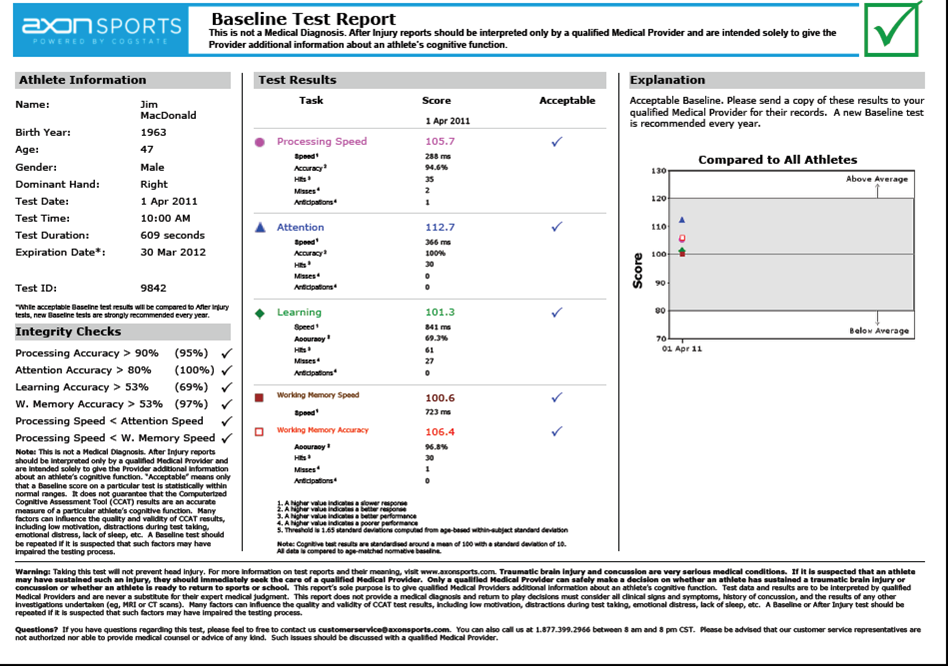
axon sport macdonald

The author’s ‘baseline’ neurocognitive test results
(AxonSport).

It has become a rite of summer over the last few years, at least here in the United States:  ‘baseline’ neurocognitive testing (typically administrered by computer).

Our practice has at this point in the summer probably tested one thousand+ local athletes from middle school to high school, primarily focusing on ‘football’ players (American football and soccer).  It is a mass demonstration of an effort at secondary prevention.  The intrinsic idea underlying this ritual is that we are establishing for each individual athlete their ‘baseline’ neurocognition, so that if they were to have a potentially concussive injury, we can re-test them and use the comparative results as one more piece of data in helping us diagnose and manage a concussion (and a return to play).

Like a lot of sports medicine, however, this practice is controversial.

An excellent article on the reliability of computerized neurocognitive tests was recently published in the Archives of Clinical Neuropsychology:  “Test-retest Reliability of Four Computerized Neurocognitive Assessment Tools in an Active Duty Military Population.” 

I am not a statistician nor a neuropsychologist, and so if some readers quibble with my definitions, I am open to hearing about it in the blog’s comments.  As I understand it, reliability is the property of a test that reduces in most respects to the concept of repeatability; some people describe it as the ‘stability’ of the test.  It is, arguably, the most basic psychometric property of a test:  one most first prove the ‘reliability’ of a test instrument before assessing other properties of the test (e.g. validity, and responsiveness).

I plan to talk more about this idea, and the study on the computerized neurocognitive tests in the Archives, in an upcoming post.  For now, I’d encourage you to don two things.

First, click on the link and read at least the abstract of the paper referenced above……the reported results from the study may surprise you.

Second, take the poll below and let us know your thoughts on this new, ‘rite of summer.’  I’ll report the results, and discuss the paper, in an upcoming blog post.   See you then!