Head guards in boxing — the podcast

mike-loosmore

Dr. Mike Loosemore, lead author of new CJSM boxing study

We open 2017 with a new podcast on the new (non)-intervention in Olympic-style boxing:  head guards, or the lack thereof.

Our guest is Dr. Mike Loosemore MBBS MSc PhD FFSEM(UK), a consultant in sport and exercise medicine at the Institute of Sport, Exercise and Health, University College London.  Dr. Loosemore is currently the doctor to the British Olympic Boxing team, and a well known figure in the boxing medicine world.

He is, as well, the lead author of a highlighted study in our January 2017 issue: The Use of Head Guards in AIBA Boxing Tournaments — A Cross-Sectional Observational Study.  The team of researchers included Julian Bailes, whose name will be familiar to most people who study and treat sport-related concussions [or familiar to those who watched the movie Concussion in 2016].

Rio 2016 was the first Olympic competition since the 1984 games in Los Angeles where male boxers did not wear head guards , a rules change which generated a lot of controversy. Research like Dr. Loosemore’s was instrumental in making the determination to stop 52 years of practice.jsm-podcast-bg-1
Just before Christmas, we chatted with Dr. Loosemore, and he shared what he and his team found in their study and the back story behind the use, and now discontinuation, of headguards in Olympic-style boxing.

Be sure to listen to the podcast here and read the study (free access currently) here…..and, as ever, let us know what you think, or give Dr. Loosemore a shout out on Twitter @doctorloosemore

 

Echocardiography as a screen to prevent SCD in athletes — 5 Questions with CJSM


cbs1

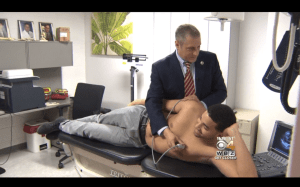
Dr. Gian Corrado performing screening cardiac ultrasound

For our first “5 Questions with CJSM” of 2017, we have a special guest:  Dr. Gianmichel Corrado, of Boston Children’s Hospital and Northeastern University.

Dr. Gian Corrado  is a doubly special guest for me: he is the lead author of a ‘published-ahead-of-print’ CJSM study and is someone who trained me in sports medicine at Boston Children’s Hospital.

I have fond memories of working alongside him, the head team physician for Northeastern University in Boston, as we cared for hockey and football athletes.  And I remember the work he was just beginning to do in his now-blossoming area of research.

The new study reports the findings of a novel ‘take’ on a controversial aspect of sports medicine: how might we screen for underlying disorders that predispose our athletes to sudden cardiac death (SCD)?

By the way, don’t let Dr. Gian Corrado’s name fool you — this is not that Dr. Corrado, (Domenico Corrado), who also has published on screening for SCD; but both Drs. Corrado share a similar concern: the primary prevention of this catastrophic event.

Dr. Gian Corrado’s approach is to use ‘screening echocardiography in front-line providers,’ and his findings can be found here:  ‘Early Screening for Cardiovascular Abnormalities with Pre-Participation Echocardiography:  Feasibility Study.’

Dr. Corrado has this to say about his important work:

_____________________________________________________________________

1. CJSM: What was the principal outcome measure you were looking at in this study? What were the secondary outcome measures?

GC: Central in the debate as to how to best identify athletes at risk for sudden death (SD) is cost-effectiveness.  The American Heart Association continues to recommend a history and physical (H&P) as the sole method for screening young athletes for the cardiac conditions that can cause SD.  The H&P has been shown to be a poor test to apply to the above dilemma as it misses athletes whom have potentially deadly cardiac conditions and falsely identifies those that do not.  Many feel that, given this reality, an electrocardiogram (ECG) screening program should be implemented.  This approach has been shown to have significant limitations as it too yields high false positive rates.  The Northeastern Group has suggested and demonstrated that with advances in portable ultrasound frontline providers (FLP) can obtain limited echocardiographic images pertinent to the structural conditions that dominate in culpability with SD. Read more of this post

Whatever happened to PE?

avery

With my friend Dr. Avery Faigenbaum — who most definitely keeps the physical in physical education.

Like many of us, I wear several hats.  My ‘day job’:  sports medicine specialist.  I also, however, have other work that consumes a great deal of time and energy and brings with it a great deal of joy and fulfillment.  I speak of my……’moonlighting job’?  My ‘real job’?

I speak of fatherhood.

I am a father to twins, thirteen years old, which turns out to be a great side gig to work as a pediatric sports medicine specialist.  My day to day interactions with my son and daughter are great preparation for my interactions in the clinic.  The skills I develop in my two ‘jobs’ complement each other.

As a father, I am reminded frequently of the differences between the schooling I enjoyed and the education my children are receiving. One of the striking differences is in the area of  non-academic offerings.   Read more of this post

Altmetrics

ga9jrnsf

Are you familiar with this logo?

As 2016 winds down, you’re all certainly aware of the power of social media. You would probably have to have been on a space ship heading to Mars to be unaware of the phenomenon of Donald Trump: TIME’s “Person of the Year”, and the president-elect of the USA, has achieved so much of his success arguably through his use of Twitter!

Imagine that.  Only a few years ago, I recall seeing people still smile at the absurdity of ‘tweeting’, of compressing ideas into a mere 140 characters.  And now we have the proverbial ‘leader of the free world’ ascendant at least in part because of his use of social media.

There is no doubt that Twitter, and other social media platforms (such as this blog, or our podcasts), have become major suppliers of information to the media consumer.  If not supplanting traditional media, social media is certainly nudging it to the side.  This is as true in the worlds of sports, sports medicine, and sports medicine research as it is elsewhere.

In the world of sports medicine research, the ‘impact factor’ has played the defining role as the measuring stick of a journal’s heft for a long time.  The metric has had its critics, but its importance has not waned.  I for one can vouch for that:  when I went ‘up’ from Assistant to Associate Professor last year, part of my application involved demonstration of publication in journals with a worthy impact factor.

At CJSM we just concluded our semi-annual associate editors meeting, bringing together a host of clinicians and researchers from around the world.  We are proud of our journal’s impact factor (2.308), but we are also self-critical and are looking for other measures of the journal’s role in the modern world.

Altmetric is one such measure.

Sound familiar?  Thinking you have heard about ‘alt-someting’ recently? Read more of this post