Cannabis and sports

d morgan

Recent tweet from @dmorg91

The intersection of social media and sports medicine has been an interest of mine (and CJSM) for some time. Today, that relationship provides an opportunity to have the blog readers take a poll about a controversial subject: the potential medical benefits of marijuana (cannabis) for active National Football League (NFL) players.

Last week Derrick Morgan (@dmorg91), an NFL player for the Tennessee Titans, tweeted, “It’s time for @NFL to take an HONEST look into the potential medical benefits of Cannabis for its players #CBD #Research.” He and colleague Eurgene Moore were also interviewed by Katie Couric about the issue.  You can see the video here.

The tweet generated a great deal of, er, buzz on social media. In the United States, 25 states and the District of Columbia have legalized marijuana for medicinal purposes, but such legal protection does not contravene employer law — that is, it may be legal to use marijuana for chronic back pain in California, but your employer can still terminate you from your position if they perform drug tests on their employees.  That is, the legal right to avoid criminal prosecution for use of marijuana does not prevent one from the requirement to participate in (and abide by) employer drug testing programs.

There are so many dimensions to this issue including the science itself about the purported benefits of cannabis, and the substance’s listing as a prohibited substance by anti-doping agencies.

But today I wanted to poll you, the readership, on the question somewhat narrowly drawn:  are you in favor of NFL players using marijuana for medicinal purposes?  I don’t intend by this poll to extend the question beyond the NFL (e.g. to Olympians), nor do I intend to enquire about the decriminalization of marijuana for recreational purposes for NFL players.  Like the Brexit vote, you get only two options: yes or no.

Let us know!!!!

And don’t ‘Bregret’ your decision, bro.

p.s. By all means, aside from voting, if you want to comment on the broader issues of marijuana use in sports (is there science behind the claims, should other sports be open to use, etc.) please do so below in the blog comments section.  Thank you!
Sports medicine: a career for all genders?

IMG_1324

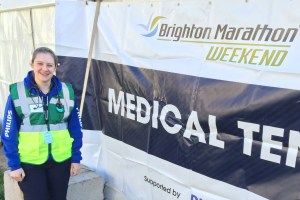
Dawn Thompson, covering Brighton Marathon

I am pleased to step aside from writing for the blog today and turn over the stage to Dawn Thompson, CJSM Junior Associate Editor and a member of the ECOSEP Junior Doctors Committee.

Dawn and I have a shared background in sports medicine, but she brings a unique perspective to today’s post:  she is a woman, she is young, and she is still in training.  I am none of these things!

If sports is a mirror of society, then it should come as no surprise that in our own professional world we may see phenomena such as gender bias.   And for those of us who benefit from male privilege (me), Dawn’s post is a great reminder of the differential burden our female colleagues may face when trying to perform the same job duties as a man.

Here in the USA, 2016 is a particularly poignant moment in time: the Democratic party’s presumptive candidate for president is Hillary Clinton.  Will that political ‘glass ceiling’ be shattered?  What of our sports medicine colleagues who are women?  Do they face their own glass ceilings?

I cede the dais to Dawn:

______________________________________________________________________

DT: It’s 1.30am on a Tuesday morning and I am wide awake. Ideas, thoughts, concepts are racing through my mind at a rate I could only dream of during normal hours. I don’t normally suffer with insomnia but I have just completed a particularly gruelling acute medical block whereby in 4 months I have worked 8 full weekends and a total of 32 nights. So as you can see my body clock is totally up the spout. There have been times when I have wondered why I chose this profession and how compatible it is with any sort of family or social life and times when I have marveled at what I feel can be the best ‘job’ in the world.

During these 4 months, Junior Doctors like myself across Britain have taken part in 6 days of industrial action in response to the proposed imposition of a contract they felt to be unsafe and unfair to patients, themselves and the NHS. One of the many complaints with regards to the new contract was the impact it could potentially have on women taking time out for maternity or to work less than full-time to raise a family. Indeed the governments own equality analysis summarised –

“While there are features of the new contract that impact disproportionately on women, of which some we expect to be advantageous and others disadvantageous, we do not consider that this would amount to indirect discrimination as the impacts can be comfortably justified” 

I have never particularly considered myself a feminist but I do expect a fair contract and I don’t expect to be treated any differently to my male counterparts based on gender rather than clinical acumen.

Data derived from the Health and Social Care Annual Workforce Publication 2014 showed that 57% of all doctors in training are female.  However things have not always been this way, in 1985 the year I was born, women made up only 16% of practicing doctors in the US. Some junior doctors are concerned that an unfair contract would send us backwards in terms of women in Medicine.  Already prior to this new proposed contract, pay inequalities exist in medicine.  A study published this week in the BMJ concluded that women doctors in the US earn less than their male counterparts even after adjusting for hours of work and specialty.

So what about the role of women in Sports Medicine? Read more of this post

Catching my breath

Cj4YEkwWEAAozwN

Part of the large contingent coming to #ACSM16 from South Africa. Photo courtesy of Phatho Zondi, current SASMA president.

I am just coming up for air after three days here in Boston, where I (and thousands of other sports medicine professionals) are attending the 2016 annual conference of the American College of Sports Medicine (ACSM).

Every year at this time I will make the pilgrimage to San Diego or Orlando or other spots in these big United States to attend this big, big conference.  Each year I leave with my brain chock full of new ideas and my bag chock full of business cards; as I step back to gain some perspective on the experience I am overwhelmed by the size and scope of the conference.  I am not complaining when I declare that it is simply not possible to attend every session one would want.  I am, rather, merely making a statement of fact!

So, like the proverbial dog trying to drink out of a gushing fire hydrant, I am doing targeted nipping at the flow of information rushing before me, and I want to share, in a most definitely non-comprehensive way, a few of the impressions I am left with as the conference heads into its penultimate day.

martin schwellnus

Slide photo courtesy of Martin Schwellnus

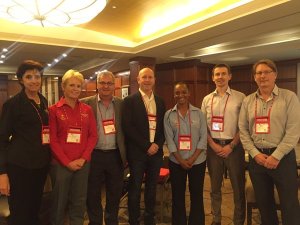
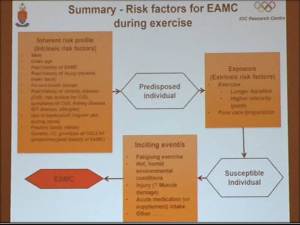
First, it’s been great to catch up with a host of South African colleagues, ranging from Martin Schwellnus, Wayne Derman and Jon Patricios, to current South African Sports Medicine Association (SASMA) president Phatho Zondi, Pierre Viviers and Christa Janse vanRensburg.  It’s tremendous to see these folks and realize the great distance they have come to contribute to the ACSM proceedings.  In terms of contribution, they most definitely ‘punch about their weight’:  one of the sessions I attended was Dr. Schwellnus’ lecture on Exercise Associated Muscle Cramping (EAMC), a subject about which we publish quite frequently at CJSM.  I learned a tremendous amount from that talk, and I am sharing one of the slides from his talk for which he gave permission to be photographed.

There are many other international attendees at ACSM.  I have seen my friend and fellow CJSM editor Hamish Osborne, who arrived from Dunedin, New Zealand (bringing to my mind the very real possibility that ACSM should start betting operation taking propositions on who will win the “Conference attendee who has travelled the furthest” award).  I have heard Chinese, Italian and French spoken. Read more of this post

CJSM Podcast 14 — Turf vs. Grass & Girls Soccer

jsm-podcast-bg-1Our newest podcast release profiles a study published in our May 2016 CJSM: Shoe and Field Surface Risk Factors for Acute Lower Extremity Injuries Among Female Youth Soccer Players. Our guest on the podcast is the lead author of the study, John O’Kane M.D., the Head Team Physician for the University of Washington and the Bob and Sally Behnke Endowed Professor for the Health of the Student Athlete.

john o kane and family

Dr. John O’Kane (L), soccer-playing daughter Katie (C), and wife Betsy (R), on grass….in Phoenix AZ

We hope you enjoy the conversation with Dr. O’Kane as much as we did.  We gained insight into the findings presented in the paper and had a fruitful discussion on some of the nuances of the endless debate:  turf vs. grass, which is the preferred surface on which to play soccer? Along the way we chatted about the recent controversies in the 2016 Women’s Soccer World Cup, as well as the impact on pubertal development as an intrinsic risk factor for injury in sport….and more!

Listen in — you can find the podcast on iTunes or on our home page.  As ever, let us know what you think — in the comment section below, or on Twitter @cjsmonline